
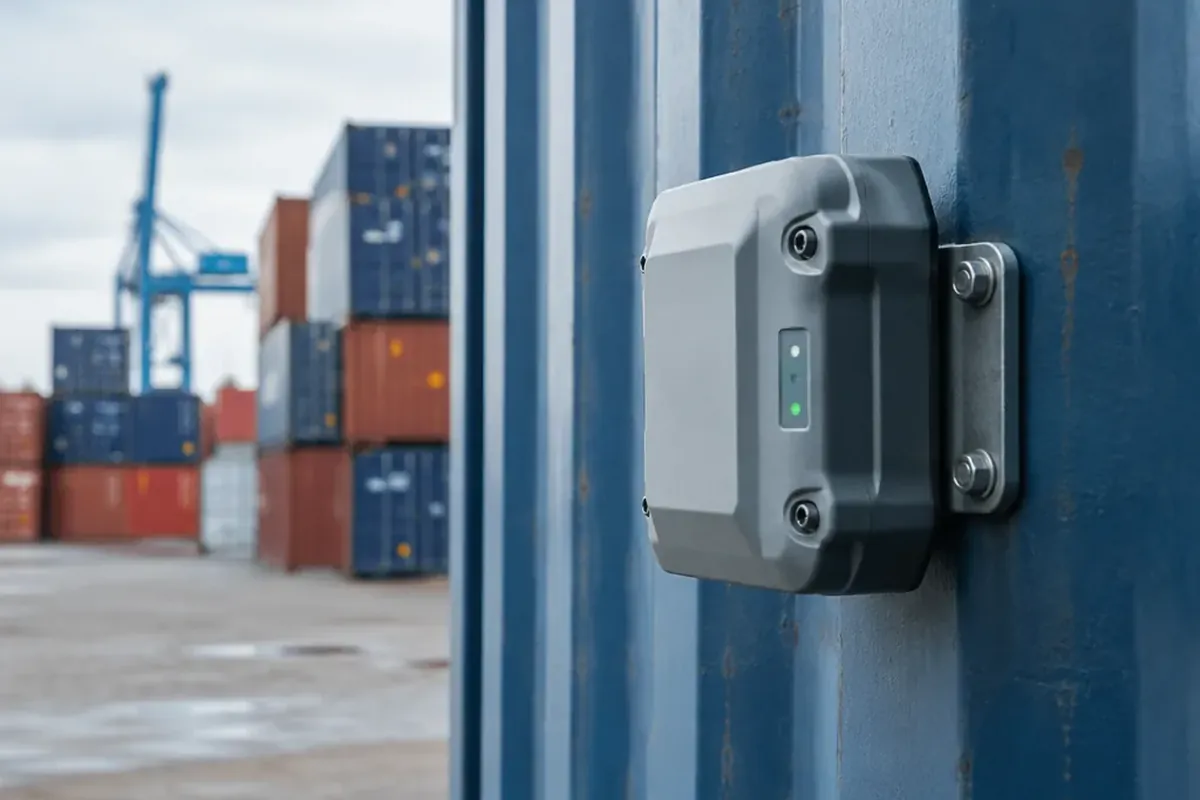
Active RFID tags carry their own battery and radio transmitter, so they broadcast a signal on their own instead of waiting for a reader. Passive tags have no battery and answer by reflecting energy from the reader’s field (backscatter). The battery lets active tags reach 100 meters and more and send sensor data in real time. Passive tags cost a fraction of the price and can work for 20+ years because there is no battery to wear out.
What Are the Different Types of RFID Tags?
RFID tags fall into three types, based on how they get power and how they communicate. GS1 defines active tags as tags with their own radio transmitter and power source, and passive tags as tags without a transmitter that answer via backscatter.
- Passive RFID Tags: These tags consist of an integrated circuit (IC) and an antenna without an internal power source. Lacking a battery, they remain inert until energized by the electromagnetic field emitted by an RFID reader, reflecting data back via backscatter.
- Active RFID Tags: Equipped with an internal battery (typically a lithium cell or coin cell) and an autonomous radio transmitter, active tags generate and broadcast their own RF signals independently without waiting for a reader signal.
- Semi-Passive Tags (Battery-Assisted Passive / BAP): A hybrid architecture where an internal battery powers only the microchip and optional sensors, while communication back to the reader still relies on passive backscatter. Because the battery does not power an active RF transmitter, it consumes significantly less power than a fully active tag.
Active RFID vs Passive RFID: Technical Specification Comparison
| Specification Parameter | Passive RFID | Battery-Assisted Passive (BAP) | Active RFID |
|---|---|---|---|
| Internal Power Source | None (harvests RF field from reader) | Internal battery (powers chip & optional sensors only) | Internal lithium or coin cell battery |
| RF Communication Method | Modulated Backscatter | Modulated Backscatter | Autonomous Radio Transmitter |
| Typical Read Range | 3–10 m (UHF typical; 30+ m with optimized setups) | 5–30 m (specialized models reach 40 to over 50 m) | 30–100+ m (150+ m open line-of-sight for beacons) |
| Operating Frequencies | LF (125–134 kHz), HF (13.56 MHz), UHF (860–960 MHz) | UHF (EPC Gen2 / 860–960 MHz) | 433 MHz, 2.45 GHz (including BLE) |
| Tag Lifespan | 20+ years (limited only by mechanical wear) | 3–8 years (battery limited) | 2–5 years (up to 10 years depending on ping rate) |
| Tag Cost per Unit | $0.05–$2.00 ($0.09+ in bulk inlays) | $5.00–$25.00 | $15.00–$100.00+ |
| Primary Use Cases | Retail inventory, item-level tracking, access control | Cold chain monitoring, perishable logistics | Yard management, RTLS, container and vehicle tracking |
Architectures of Active RFID: Beacons, Transponders, and Mobile Apps
Active RFID tags transmit data using primary communication configurations engineered for distinct logistical requirements:
- Beacon Tags: The most widespread form of active RFID tag. Beacons autonomously broadcast their identification payload and telemetry at pre-programmed intervals ranging from every 100 milliseconds to every 5 seconds. A beacon configured to ping every 3 to 5 seconds achieves a longer lifespan than a transponder tag that responds to every reader signal.
- Transponder Tags: These active tags listen for signals from a reader and respond only upon inquiry, sending a battery-powered signal roughly 100,000 times stronger than passive reflections. Transponders are used almost exclusively in transit environments, such as E-ZPass highway tolling systems, allowing vehicles to be identified at highway speeds.
- Intelligent RFID: A hybrid architecture where the tag wakes up at intervals, determines its own location relative to reference beacons, and transmits its position to a reader.
Frequency selection dictates physical performance. The 433 MHz band utilizes an approximate 1-meter wavelength, allowing signals to propagate better around metal and water in industrial and logistics environments. A 433 MHz system requires less than 1 mW of power for 100-meter communication, compared to 100 mW or more required in the 915 MHz band. 433 MHz is also the most widely used active RFID frequency, with logistics networks in more than 20 countries. The 2.45 GHz band, by contrast, support compact form factors, higher bandwidth for sensor data, and can be read directly with commercial off-the-shelf smartphones.
Battery-Assisted Passive (BAP) Systems in Sensor-Driven Cold Chains
Battery-assisted passive technology bridges the gap between passive tags and active transmitters. By supplying battery power exclusively to the microchip, BAP devices support larger rewritable memory and onboard environmental sensors without expending energy on active radio transmission.
The EM Microelectronic EM4325 IC exemplifies this architecture. Operating as a UHF EPC Gen2 silicon chip, it incorporates an integrated temperature sensor operating between -40°C and +60°C alongside 4 kBit of EEPROM storage. In BAP configuration, the chip supports read ranges exceeding 50 meters and enables monitoring intervals from 5 minutes to 8 hours with alarm timestamp logging (full historic temperature curve recording requires an external microcontroller). Commercial BAP temperature labels reach read distances of up to 40 meters (130 feet) in battery-assisted mode while weighing only a few grams, which makes them practical for cold chain monitoring in pharmaceutical and food logistics.
Industrial RTLS and Yard Management vs. Retail Inventory Tracking
The economic divergence between passive and active hardware determines system deployment at scale. Equipping 10,000 shipping pallets with passive RFID labels requires an expenditure ranging from several hundred to a few thousand dollars, with individual passive labels priced between $0.05 and $2.00. Outfitting that same inventory volume with active RFID tags costing $15 to $100+ per unit demands a capital investment well into six figures.
Because of this financial contrast, item-level retail asset tracking and inventory management rely on passive UHF hardware paired with fixed readers or handheld scanners, which typically list for well over $1,000 each. Active systems dominate Real-Time Location Systems (RTLS) for containers, vehicles, and trailers across ports and large industrial grounds. A single active RFID reader can cover an operational footprint of up to 10,000 square feet (approximately 930 square meters). In yard management workflows, active tags secured to trailers, containers, and forklifts provide location tracking with positioning accuracy under 1 meter, alongside real-time monitoring of shock, motion, and temperature that passive tags cannot gather.
Myths and Misconceptions in RFID Implementations
- Myth: Active RFID Always Replaces Passive RFID for Better Performance: Active tags provide long range (30 to 100+ meters, with long-range RTLS systems under ISO/IEC 24730-2 transmitting over thousands of meters), but they are unsuitable for item-level retail inventory due to size and unit cost. Passive UHF remains the industry standard for dense counting where readers scan over 100 tags per second using anti-collision algorithms.
- Myth: Passive Tags Have an Expiration Date: Passive tags contain no battery to degrade over time. The lifespan is limited only by mechanical wear, allowing passive tags to function for more than 20 years.
- Myth: RFID and NFC Are Mutually Exclusive Competitors: NFC is a subset of High-Frequency (HF) RFID running at 13.56 MHz designed for two-way communication and short distances up to 4 centimeters. While passive UHF RAIN RFID handles logistics and inventory across long distances, NFC provides encryption and authentication for secure close-range transactions like payments.
- Myth: RFID Is a Modern Invention: Radio-based tracking dates back to World War II, when the British military developed the “Identify Friend or Foe” (IFF) system using radio waves to distinguish friendly aircraft from hostile forces.
Frequently Asked Questions
What are the different types of RFID tags?
There are three primary types of RFID tags: passive tags, active tags, and semi-passive (battery-assisted passive or BAP) tags. Passive tags lack internal power and rely on reader-generated RF fields to communicate via backscatter. Active tags contain an internal battery and autonomous transmitter that broadcasts signals over long distances. Semi-passive tags use an internal battery solely to run onboard sensors and the microchip while relying on backscatter reflection for communication.
What is the typical cost of an RFID tag per unit?
Passive RFID labels generally cost between $0.05 and $2.00 per unit, with high-volume inlay purchases starting around $0.09. Semi-passive (BAP) tags range from $5.00 to $25.00 each. Active RFID tags cost between $15.00 and $100.00 or more per tag depending on robustness and wireless technology.
Who manufactures RFID tags?
Prominent global manufacturers of RFID tags and labels include Avery Dennison, Alien Technology, Zebra Technologies, Honeywell, HID Global, SATO, Checkpoint Systems, and Beontag. Key chip and specialty tag providers include NXP Semiconductors, Impinj, Omni-ID, Confidex, and Murata.
Which is better, NFC or RFID?
Neither technology is universally better; selection depends on operational scope. RAIN RFID (passive UHF) is superior for warehouse management and reading over 100 items per second over distances up to 10 meters. NFC (a subset of HF RFID operating at 13.56 MHz) is designed for secure, short-range (up to 4 cm) transactions, supporting built-in encryption and authentication for contactless payments.
Do hotel rooms use RFID or NFC?
The vast majority of commercial hotel locking systems use 13.56 MHz HF RFID physical keycards, frequently utilizing platforms such as MIFARE Classic, Ultralight C, or MIFARE DESFire EV3 (certified to Common Criteria EAL5+ with 128-bit AES encryption). NFC is deployed alongside physical RFID cards for mobile key solutions on smartphones, while maintaining RFID cards as backup entry.
Are credit cards NFC or RFID?
Contactless credit cards utilize Near Field Communication (NFC), a subset of 13.56 MHz High-Frequency RFID. Identified by the contactless symbol displaying four curved lines, these cards incorporate an embedded EMV chip that encrypts every transaction with a dynamic, one-time token, making it more secure than a magnetic stripe.