
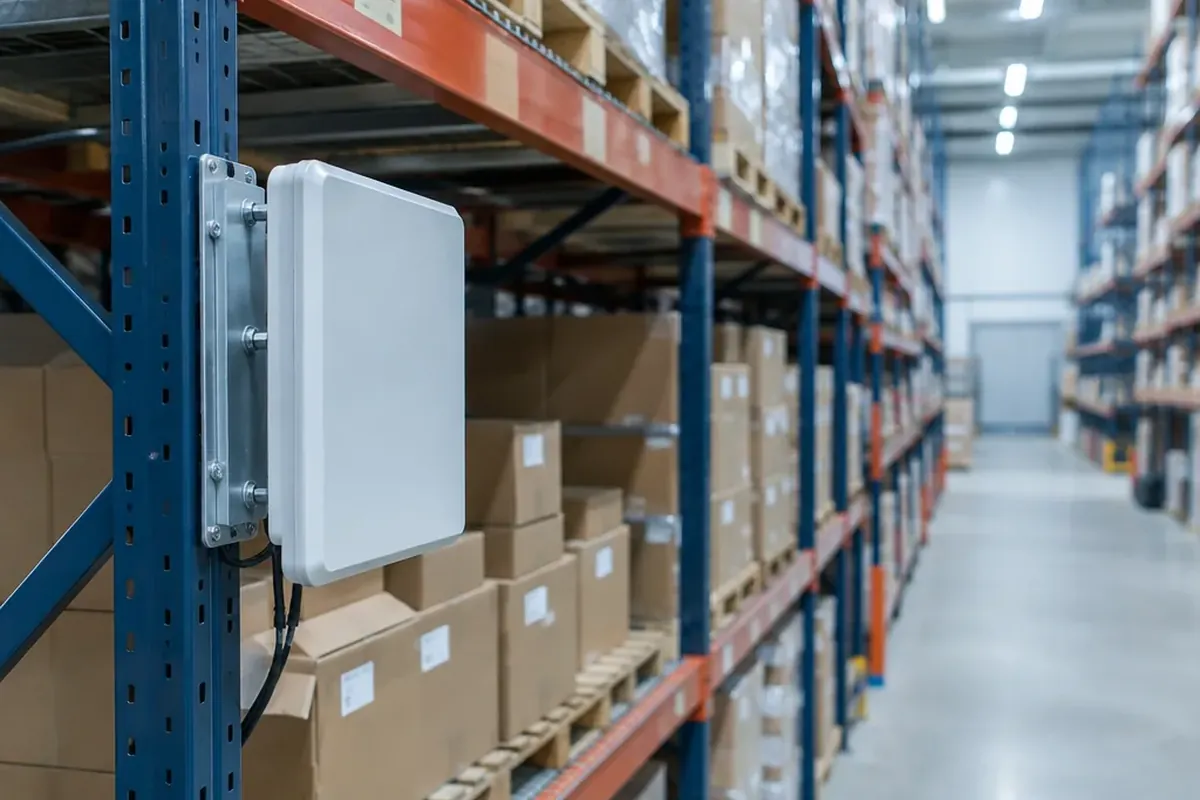
An RFID tag can be read anywhere from direct contact to over 100 meters away, but there is no single universal rfid range. A low-frequency transponder requires proximity within 4 inches (10 cm), whereas a passive ultra-high-frequency tag can be captured at up to 30 feet (10 m), and an active battery-powered tag can reach 100 meters or more. The actual communication distance is governed by operating frequency, transponder power architecture, antenna polarization, reader sensitivity, and the physical materials surrounding the tag.
Operating Frequencies: What Determines RFID Range
Radio frequency identification systems operate across three primary frequency bands: Low Frequency (LF), High Frequency (HF), and Ultra-High Frequency (UHF). Each band relies on different electromagnetic physics, creating distinct reading boundaries and performance characteristics.
| Frequency Band | Standard Operating Frequencies | Key ISO Standards | Typical Read Range | Signal Behavior & Physics |
|---|---|---|---|---|
| Low Frequency (LF) | 125–134 kHz | ISO 18000-2 | Near contact to 4 inches (10 cm) | Works in metallic environments and near liquids. |
| High Frequency (HF) | 13.56 MHz | ISO 15693, ISO 14443 | Centimeters up to 3 feet (1 m) | Near-field coupling; forms a tight 0–30 cm bubble with power dropping 87.5% per distance doubling. |
| Passive UHF (RAIN) | 860–960 MHz | EPC Gen2 / ISO 18000-63 | Several meters up to 30 feet (10 m; up to 15–20 m in special cases) | Far-field coupling; subject to inverse-square power loss of 75% per distance doubling. |
| Active RFID | 433 MHz, 2.45 GHz | ISO 18000-7 (433 MHz) | Tens of meters to 100 m in open space; 200+ m in some systems | Autonomous radio transmission powered by internal battery. |
Low Frequency (LF) operates at 125–134 kHz under ISO 18000-2 and reaches up to 10 cm (4 inches). LF works effectively near liquids and in metallic environments.
High Frequency (HF) at 13.56 MHz divides into two primary standard families. ISO 14443 transponders, such as access badges and NFC payment cards, are built for tap-range reads of a few centimeters. In contrast, ISO 15693 transponders reach from a few inches up to about 3 feet (1 meter) when paired with a good antenna. In June 2025, the NFC Forum Release 15 raised the certified compliant operating range from 0.5 cm to 2 cm, representing a fourfold increase.
Passive Ultra-High Frequency (UHF) systems operate between 860 and 960 MHz (with regional allocations such as 865–928 MHz under EPC Gen2 / ISO 18000-63). UHF passive tags typically read several meters up to 10 meters (30 feet), reaching up to 15 meters in special cases and up to 20 meters when interrogated by phased-array readers.
Passive vs. Active Architectures: How Power Dictates Distance
An RFID transponder falls into one of three power classifications: passive, active, or battery-assisted passive (BAP). The presence or absence of an onboard power source is a primary factor in system read distance.
- Passive RFID Tags: Passive tags contain no onboard battery. They rely on the reader’s signal to operate. Passive LF reaches up to 10 cm, passive HF up to 1 meter (usually less), and passive UHF up to 10 meters depending on antenna and environment. Two tags of the same frequency can differ in range by a factor of two or more because vendors measure in ideal conditions.
- Battery-Assisted Passive (BAP) Tags: BAP devices use a small battery for the chip but rely on the reader’s signal; typical range spans 15 to 30 meters.
- Active RFID Tags: Active tags feature an internal battery and broadcast their own signal at 433 MHz or 2.45 GHz. Instead of reflecting a reader signal, active tags send their own, typically across tens of meters up to about 100 meters in open space. Systems for vehicle tracking, mining, and Real-Time Location Systems (RTLS) can reach 200 meters and more.
Antenna Gain, Reader Power, and Polarization Mechanics
In passive UHF deployments, far-field reader power follows an inverse-square law: doubling distance reduces received power by 75%.
Reader transmit power is given in decibels (dBm), where every increase of 3 dB doubles the power (for example, 27 dBm is twice 24 dBm). Reader antenna ratings and hardware settings directly impact range:
- Antenna Gain: Antennas rated at 8 dBi or higher are considered high gain and increase range, whereas gain levels of 7 dBi or lower are considered low gain for short-range systems.
- Receiver Sensitivity: Maximum receive sensitivity allows the reader to detect weaker tags from farther away, whereas lower sensitivity ignores them.
- Linear vs. Circular Polarization: Linearly polarized antennas provide longer read range than circularly polarized antennas, but tag orientation matters: tags must align with the antenna’s emission plane. Circularly polarized antennas read tags in any orientation (horizontal, vertical, or in between) but sacrifice roughly 3 dB of gain compared to linear antennas. Reading a tag from an angle reduces range; for maximum range, tag and antenna should face each other perpendicularly.
The Impact of Metals and Liquids on Signal Integrity
UHF radio waves reflect off metal surfaces and are absorbed by water and liquids, degrading performance without specialized tag designs.
Solving metallic interference for UHF requires on-metal tag designs engineered with a spacer layer or different antenna design (such as foam-backed tags) to maintain resonance on conductive surfaces. While on-metal tags cost more than standard labels, they solve most supply chain cases near metal.
In contrast, Low-Frequency (LF) waves penetrate both metallic surroundings and liquids. High-Frequency (HF) near-field energy is less affected by metals and liquids at typical ranges, making HF more reliable on metallic objects and liquid-filled containers.
Regulatory Power Caps: FCC vs. ETSI Standards
Because UHF systems use public radio spectrum, maximum achievable range is bounded by regional regulations:
In the United States, UHF RFID operates at 902–928 MHz under FCC Part 15.247, providing 26 MHz of bandwidth across 52 channels of 500 kHz. The FCC allows reader transmitters up to 1 watt conducted power, or up to 4 watts EIRP with a directional antenna and hopping across at least 50 channels. Configuring fewer than 50 hopping channels can force power reductions.
In Europe, ETSI EN 302-208 limits UHF RFID to 865–868 MHz (only 3 MHz bandwidth) and caps radiated output at 2 watts ERP, mandating listen-before-talk rather than duty-cycle limits.
Because operating allocations differ, a UHF tag built for the US 902–928 MHz band can fail to work in Europe (865–868 MHz), and vice versa. LF (125–134 kHz) and HF (13.56 MHz) regulations, by contrast, are harmonized enough worldwide that they rarely affect purchasing decisions.
Field Testing and Optimization Guidelines
Testing should be conducted with real tags on real products in the actual building at the speed they move, rather than relying on ideal lab conditions. Actual deployment sites contain metal structures, interference sources, and movement patterns that alter range.
Key guidelines for field testing and calibration include:
- Avoid Biological Detuning: The RAIN RFID Alliance recommends avoiding skin contact with UHF tags while they communicate, because body water detunes them. Handlers should use dry wooden chopsticks or cloth pegs. If manual handling is necessary, a fingertip pinch grip at the center of the antenna produces the smallest detuning effect.
- Adjust Reader Positioning: Adjusting reader antenna tilt, height, and polarization dramatically affects field uniformity and capture probability.
- Size the Tag Antenna: Larger tags have larger antennas that broadcast farther, while smaller tags have shorter read range. UHF dipole tags typically range from 10 × 10 mm to 100 × 15 mm.
- Audit Channel Hopping: In the US, confirm the reader hops across at least 50 channels to maintain legal compliance and prevent forced power reductions.
Common RFID Range Myths and Misconceptions
- Myth 1: Cranking reader power to maximum always improves performance. Increasing reader power does not guarantee longer range. Excessive power can cause interference, multipath effects, and unwanted tag excitation outside the intended zone.
- Myth 2: Aluminum foil completely blocks RFID. Foil weakens or blocks signals when wrapping a card completely with no gaps based on the Faraday cage principle, but in everyday use, creases, tears, and open edges let signals through.
- Myth 3: Passive RFID tags allow real-time location tracking. Passive RFID does not track location in real time; it only reports a tag when it passes within range of a reader (typically up to 5 meters). Continuous real-time tracking needs battery-powered tags, such as active RFID.
Frequently Asked Questions
How do I know my RFID frequency?
Check the standard associated with the hardware: ISO 18000-2 indicates Low Frequency (LF at 125–134 kHz), ISO 15693 or ISO 14443 indicates High Frequency (HF at 13.56 MHz), and ISO 18000-6 designates UHF. Hardware operating at 902–928 MHz corresponds to US UHF, while 865–868 MHz corresponds to European UHF. In addition, most smartphones only read HF/NFC (13.56 MHz) and require a dedicated reader to detect LF or UHF tags.
Can RFID detect location?
Passive RFID does not track location in real time; it only reports a tag when it passes within reader range (up to 5 meters). Real-Time Location Systems (RTLS) utilize active RFID tags that transmit continuously. RTLS can determine position via Received Signal Strength Indicator (RSSI) triangulation, where three or more receivers calculate position from signal strength.
Which is better, NFC or RFID?
NFC is a subset of HF RFID at 13.56 MHz: every NFC tag is an RFID tag, but not every RFID tag is NFC. NFC is designed for two-way (device-to-device) communication at a typical tap distance of about 4 cm, reading one device at a time. In contrast, standard passive UHF RFID is primarily one-way (reader-to-tag), reading dozens of tags in a single pass at distances up to about 30 feet, while active RFID reaches 100+ feet.
What are the key differences between UHF and HF RFID technology?
UHF (860–960 MHz, ISO 18000-6C) relies on far-field coupling to form a read cone of 1 to 12 meters with power dropping 75% per distance doubling, picks up hundreds of tags in a single pass, transfers data at 40 to 640 kbps, uses small dipole antennas (10 × 10 mm to 100 × 15 mm), and features tag costs of $0.03 to $0.10. HF (13.56 MHz, ISO 15693/14443) operates via near-field coupling forming a 0 to 30 cm bubble with power dropping 87.5% per distance doubling, reads centimeters to about 1 meter, tops out around 20 tags at a time, transfers data at 106 to 848 kbps, uses larger coil antennas (30 × 30 mm to 85 × 54 mm), and costs $0.08 to $0.30 per chip card.
Does aluminum foil really block RFID?
Aluminum foil can weaken or block a card’s signal when it fully surrounds the card with no gaps based on the Faraday cage principle, but everyday foil does not reliably block RFID because creases, tears, and open edges let signals through. In a home test, an ID card wrapped in foil was still detected by a reader at about 2 inches, compared to 18 inches without foil. Furthermore, UHF RFID with strong reader power may still detect a foil-wrapped tag at close range, whereas NFC (13.56 MHz) is easier to block than UHF.
What are the downsides of RFID technology?
Key limitations include UHF signal absorption by liquids and reflection off metals, cutting read range sharply without careful tag placement. RFID tags can be read without the owner’s knowledge, raising privacy concerns due to the lack of built-in encryption on many passive tags. Deployments can suffer radio interference from other devices in the same or nearby bands, worsened by high-power or collocated readers. Additionally, tags designed for one regulatory region (such as the US 902–928 MHz band) may not work in another (EU 865–868 MHz), complicating global logistics. Finally, using the “kill” command for permanent tag deactivation requires reading the tag at the point of sale, which can be missed.