
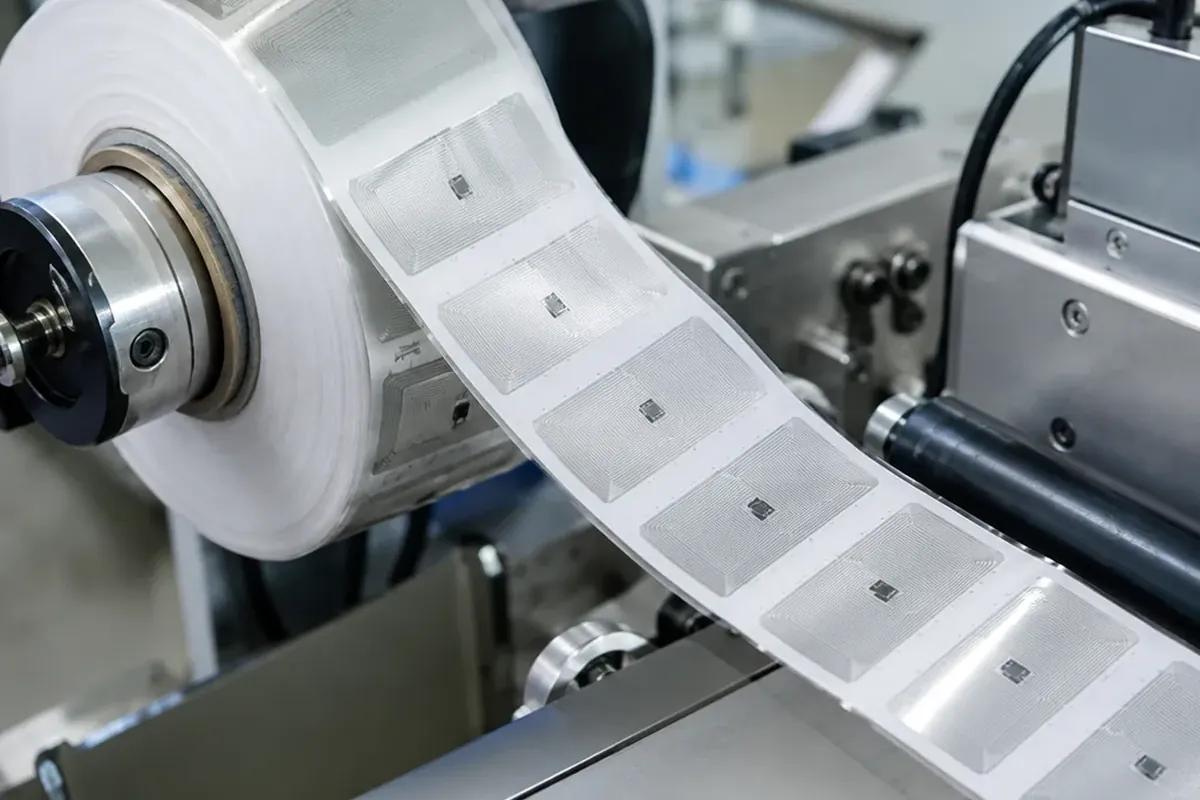
An RFID inlay is the functional core of an RFID transponder, consisting of an integrated circuit (chip) and a tuned antenna mounted on a thin, flexible substrate film (mostly PET film). The inlay harvests energy from a reader’s radio signal to transmit stored data without requiring direct line-of-sight contact.
What Is an RFID Inlay? Architecture and Core Components
An RFID inlay is an unhoused, raw transponder assembly. It offers no protective housing and no printability, serving as a raw component supplied on rolls to converters, who transform it into finished labels or encapsulated tags.
Every passive ultra-high frequency (UHF) inlay relies on three interconnected components:
- The Integrated Circuit (IC): The chip stores identification data and security parameters. In RAIN RFID configurations, the IC contains four memory banks: the Tag Identifier (TID) with the chip manufacturer’s ID, the Electronic Product Code (EPC) for product identification, Reserved memory for passwords, and User memory for optional data. A typical passive UHF chip allocates 96 bits of storage to the EPC bank, which is enough for a unique serial number, while specialized sectors such as the automotive industry utilize chips with up to 640 bits.
- The Antenna: Tuned to the operating frequency, the antenna is made of conductive material: traditionally etched copper, today mostly etched aluminum or printed conductive silver paste. It captures electromagnetic energy emitted by the reader signal to power the passive chip. UHF chips exhibit a complex (capacitive) input impedance; the antenna is designed with a conjugate-complex (inductive) impedance to transfer maximum power.
- The Carrier Substrate: The chip and antenna are supported by a thin, flexible substrate (mostly PET film). The chip is attached using an anisotropic conductive adhesive in a flip-chip process that cures under temperature and pressure. In roll-to-roll production, an RFID strap (a chip with two enlarged contact pads on a carrier layer) can be used to enable faster assembly and higher yields.
RFID Inlay vs. Label vs. Hard Tag: Key Differences
An inlay provides the functional core, a label is ready for immediate application, and a hard tag is engineered for harsh operational environments.
| Parameter | RFID Inlay | RFID Label | RFID Hard Tag |
|---|---|---|---|
| Physical Construction | Raw chip and antenna mounted on thin, flexible substrate (mostly PET) | Inlay embedded between printable face stock and adhesive layer with release liner | Inlay encapsulated in rigid housing made of ABS, polycarbonate, ceramic, or epoxy |
| Durability & Resistance | No housing protection | Standard label durability; ready to apply like a sticker | High; engineered against heavy impact, water, chemicals, and extreme temperatures |
| Printability | Non-printable | Printable and encodable | Non-printable housing |
| Typical Unit Weight | Under 1 gram (paper-thin) | Under 1 gram (paper-thin) | Up to 250 grams |
| Indicative Unit Cost | Starting at approximately $0.03 in high manufacturing volumes | Moderate | $1.00 to over $15.00 depending on features |
| Primary Purpose | Raw component for converters | Ready-to-use smart label applied to products, packaging, and assets | Harsh and demanding environments |
Dry vs. Wet Inlays: Selecting the Production Format
Inlays are ordered in distinct formats depending on how they will be processed downstream:
- Dry Inlays: Delivered without any adhesive layer, dry inlays are intended for further converting through lamination or embedding. They offer greater freedom in size, shape, and adhesive selection during converting.
- Wet Inlays: Dry inlays backed with a pressure-sensitive adhesive layer (acrylic or hot-melt) and a release liner. They can be applied directly onto a product, though they are available only in limited formats and adhesive options.
- White Wet Inlays: Also known as stickers, these are wet inlays with a white face sheet. They are frequently used directly by retailers as ready-to-use RFID labels.
Antenna Geometry, Polarization, and Read Range
The most common UHF tag antenna is the dipole, often designed as a meandered (coiled) conductor line to reduce overall dimensions. Other antenna designs include folded dipoles, inverted-F antennas, patch antennas (for metal), slot antennas, and text antennas where letters serve as the radiating element.
Antenna dimensions directly affect performance: a larger antenna captures more energy and provides a greater read range (as a guideline: 12–20 meters for high-end UHF inlays), whereas miniaturization down to a few millimeters almost always reduces range. The antenna impedance must match the chip impedance (conjugate-complex matching); otherwise, insufficient power is transferred and the tag does not respond. Dual-polarized antennas (such as crossed dipoles) enable reading regardless of the tag’s orientation relative to the reader.
The Converting Process: How Inlays Become Finished RFID Labels
Converting starts with inlays on a roll, which are cut to the desired label format and joined with adhesive and backing layers. A typical wet-inlay converting line runs through these steps:
- Delamination: Separating the printable face stock from the liner.
- Inlay Testing: Testing the inlay before insertion.
- Inlay Insertion: Cutting and placing the inlay onto the liner. Inlays can be processed “on pitch” (label length matches inlay spacing) or “off pitch” (label length is independent of inlay spacing, requiring servo presses).
- Lamination: Laminating the face stock over the transponder and liner.
- Die-Cutting: Die-cutting the finished label shape.
- Testing and Marking: Testing each tag for readability at the end of the line; defective tags are marked and replaced in a second run.
- Final Formatting: Converting into rolls or sheets.
- Printing and Encoding: Printing visible information and programming the chip in a single pass.
Write speed is physically limited: UHF chips require several milliseconds per write cycle, and line speed must be matched accordingly. Typical converting errors include improper web tension (too much tension cracks the IC, too little lets the layers separate) and incorrect inlay positioning, which results in inaccurate printing and reading results.
Material Interference and Environmental Tagging Guidelines
Materials in the vicinity of an inlay influence radio waves and operational performance:
- Metal Reflections: Metals reflect radio waves and detune standard tags. Tagging metal assets requires specialized on-metal tags with spacers (such as foam) or patch antennas.
- Liquid Absorption: Liquids absorb UHF energy. Tags on liquid containers must be kept away from the liquid using flag labels, collars, or spacers.
- Dielectric Loading: Plastic, cardboard, glass, and wood have a dielectric effect that slightly shifts the resonant frequency; tags are often preset for typical cardboard or plastic environments.
Guidelines from the Auburn RFID Lab recommend: never adhere an inlay directly onto bare metal, never staple or punch through an inlay, and apply only a single RFID tag per product.
Common Myths and Misconceptions About RFID Inlays
- Myth 1: An RFID inlay on clothing can track your real-time movements via satellite. Passive UHF apparel tags have no battery, GPS, or mobile connectivity to transmit location data to satellites.
- Myth 2: Any kitchen foil creates an impenetrable barrier against RFID scanning. Aluminum foil attenuates or blocks signals only if it completely encloses the tag without gaps or folds. Purpose-built shielding tapes made of 5-mil aluminum foil with a pressure-sensitive adhesive block around 96% of RFID signals, about as well as 1 mm of stainless steel.
- Myth 3: An RFID tag replaces the need for barcodes entirely. An RFID label combines a printable label structure with an embedded RFID inlay, carrying visible information (text, barcode, logo) and machine-readable digital data simultaneously.
Frequently Asked Questions
What does RFID stand for?
RFID stands for Radio Frequency Identification. Defined by the IEEE as a wireless data collection technology, RFID uses radio frequency signals to identify and track objects, animals, or people without requiring physical contact or direct line-of-sight.
What does an RFID label look like?
From the outside, an RFID label looks like an ordinary barcode sticker, with the chip and antenna invisibly embedded inside. Labels can often be recognized by an RFID or EPC symbol on the surface or a slight bump (chip bump). A typical label has a multi-layer construction: a printable face stock (paper or plastic), the inlay (chip and antenna), an adhesive layer, and a release liner.
What is RFID labelling?
RFID labelling is the process of selecting, printing, encoding, and applying RFID labels onto products, packaging, and assets.
Who are the biggest RFID manufacturers?
The five largest companies in the RFID market are NXP Semiconductors, Zebra Technologies, Impinj, HID Global, and Avery Dennison, which together held a 48.9% market share in 2025. Avery Dennison is the largest inlay converter, with Intelligent Labels sales of over $900 million in 2025. Other major inlay manufacturers include Checkpoint Systems, SML Group, Beontag, Tageos, Alien Technology, and Invengo.
Can RFID tags on clothes be tracked?
Passive UHF RFID tags on clothing can only be read by an active reader within a range of 3 to 10 meters and store only a product identifier rather than personal data. Furthermore, most retailers deactivate (“kill”) the tag at checkout using the EPC Gen2 kill command, rendering the chip permanently unusable. If a tag was not deactivated, any RFID reader within that range can still read its product ID.
What material will block RFID?
A completely enclosed Faraday cage made of conductive material blocks RFID across all frequencies. Conductive materials such as aluminum foil, copper, steel, conductive fabrics (such as carbon fiber), and mu-metal also act as RFID blockers, with effectiveness depending on frequency band, thickness, and closure.