
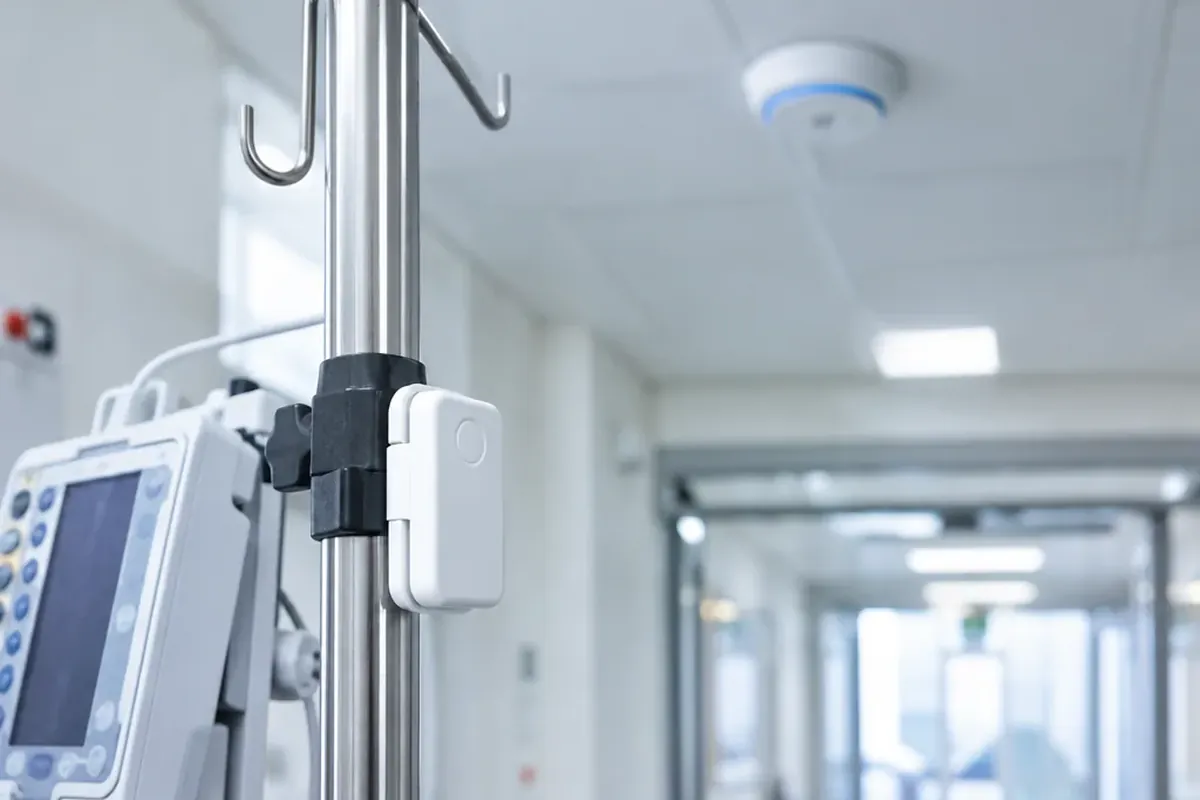
A real time locating system (RTLS) is a wireless system designed to identify and track the location of objects or people in real time within a building or contained area. As defined by the international standard ISO/IEC 24730-1, an RTLS represents “wireless systems with the ability to locate the position of an item anywhere in a defined space.” RTLS operates as a local positioning system rather than GPS or mobile phone tracking, and the transmitted data typically does not include the speed, direction, or spatial orientation of tracked assets.
What Is a Real Time Locating System and How Does It Work?
An RTLS is not a singular technology, but an operational outcome achieved through diverse auto-ID technologies, including Ultra-Wideband (UWB), Bluetooth Low Energy (BLE), Wi-Fi, active RFID, infrared light, and ultrasound. Commercial RTLS originated in the early 1990s, when the first systems were installed across three US healthcare facilities using infrared light signals from actively transmitting tags. The term “RTLS” was created circa 1998 at the ID EXPO trade show by Tim Harrington (WhereNet), Jay Werb (PinPoint), and Bert Moore (AIM) to describe technology combining active RFID identification with on-screen location display.
A typical real-time location tracking deployment follows five steps:
- Signal Transmission: An active tag attached to an asset or carried by a person transmits a unique identification signal at pre-configured intervals.
- Signal Capture: Fixed location sensors or anchors mounted throughout the monitored area receive the signal and measure timing and signal strength.
- Coordinate Calculation: A central location engine processes sensor data using algorithms such as Time Difference of Arrival (TDoA) or trilateration to calculate the position.
- Data Filtering and Routing: Middleware cleans the data by removing duplicate events, consolidating streams, routing updates, and maintaining history.
- Application Display: The cleaned positioning data feeds into user applications to display real-time coordinates on a live map.
Core Architecture: Anchors, Engines, and Real Time Locating System Software
An RTLS consists of four main parts: tags, location sensors or anchors, a location engine, and middleware with business applications.
At the tracking layer, tags come as active (battery-powered, self-transmitting), passive (no battery, activated by reader signals), or semi-active. Active tags feature programmable transmit rates (“blink” rates) configured from milliseconds to minutes depending on application requirements. In production environments, UWB RTLS can update vehicle tags every 100 milliseconds, personnel tags every 333 milliseconds, and asset tags every 1 second. Fixed anchors installed throughout the facility capture tag transmissions, record timing and power measurements, and forward telemetry to the location engine.
The location engine functions as the computational core. Running on dedicated server hardware, the engine can execute up to 3,000 coordinate calculations per second. The engine feeds data into middleware, which serves as plumbing between core RTLS components and business systems by handling filtering, consolidation, routing, storage, and history maintenance.
Enterprise real time locating system software provides real-time maps, history playback (“track history”) to replay asset trajectories over selected timeframes, heatmaps, zone-based alerts, geofencing, and dwell-time analytics. Platforms offer REST and MQTT APIs to connect positioning feeds directly into Enterprise Resource Planning (ERP), Warehouse Management Systems (WMS), and Manufacturing Execution Systems (MES). In operational facilities, workers use a mobile real time locating system app on smartphones or vehicle PDAs to locate items on 2D floor plans, cutting search time by up to 96% in warehouse settings.
Comparing RTLS Technologies: UWB, BLE, Wi-Fi, and Active RFID
Selecting an RTLS requires matching positioning methods to operational needs. Deployments rely either on choke-point locating (presence registered when a short-range tag passes a single reader) or relative-coordinate locating (multiple readers receive signals and calculate exact positions using algorithms like trilateration, multilateration, or Angle of Arrival).
| Technology | Typical Accuracy | Measurement Method | Typical Tag Battery Life | Tag Cost Range | Infrastructure Cost Range |
|---|---|---|---|---|---|
| Ultra-Wideband (UWB) | 10–30 cm | Time of Flight (ToF) / TDoA | ~1 year (frequent updates) | €15–€60 | €15–€40 / m² |
| Bluetooth Low Energy (BLE) | 1–5 m (0.5–1 m AoA) | Signal Strength (RSSI) / Angle of Arrival (AoA) | 2–7 years (coin cell) | €5–€30 | €4–€12 / m² (AoA) |
| Wi-Fi (Enterprise APs) | 3–10 m (5–10 m NHS) | RSSI Fingerprinting / FTM (802.11mc) | Varies by client device | Varies by client device | Zero extra cost (existing APs) |
| Active RFID (ISO/IEC 24730-2) | Varies by system | Choke-point / Long-range signal (up to thousands of meters) | 3–5 years | $15–$100 | Varies by reader layout |
| Passive RFID | Zone level at choke points (up to ~20 m) | Reader proximity | No battery | €0.05–€0.50 | €1–€4 / m² |
Ultra-Wideband delivers the highest precision among common RTLS options. UWB pulses last less than 2 nanoseconds, enabling Time of Flight (ToF) measurements that achieve 30-centimeter accuracy 99.9% of the time in industrial settings, even near metal, Wi-Fi, and BLE interference. One academic study using three UWB anchors in a 6 m × 6 m indoor space recorded an average position error of 12.2 cm. In a separate 2D test with four UWB anchors, an area of 60 square meters showed a root mean square error of 0.38 meters, increasing to 0.70 meters when expanded to 91.4 square meters.
Bluetooth Low Energy serves as the workhorse for mainstream tracking. BLE positioning using RSSI estimates distance via signal attenuation to achieve 1 to 5 meter accuracy, with tags running 2 to 7 years on a coin cell. Where higher precision is required, BLE Angle of Arrival (AoA) with antenna arrays can achieve 0.5 to 1 meter accuracy in ideal conditions. BLE is practical because many modern enterprise Wi-Fi access points include an integrated BLE radio, eliminating the need for a dedicated overlay network.
Wi-Fi RTLS using RSSI fingerprinting typically provides 3 to 8 meter accuracy (the NHS UK notes 5 to 10 meters depending on access-point density and obstructions). Wi-Fi Fine Timing Measurement (FTM / 802.11mc) promises sub-meter accuracy but has low client and infrastructure adoption. MAC address randomization, enabled by default on Apple and Android devices, interferes with Wi-Fi tracking; it can usually be switched off in device settings to permit tracking.
What Are the Key Differences Between RTLS and RFID?
Standard RFID and RTLS serve different operational roles:
- RFID answers “Did this item pass a reader?” Passive RFID provides presence detection at a specific point. Tags carry no battery, operate up to about 20 meters, and activate only when energized by a nearby reader beam. Passive RFID accuracy degrades significantly near metal and water.
- RTLS answers “Where is this item right now?” RTLS provides continuous position monitoring over an entire area. Active tags carry an onboard battery and electronics, allowing fixed sensors to track coordinates across a facility.
Cost structures reflect these differences. Passive RFID tags cost from a few cents to €0.50 each, with presence detection infrastructure costing €1 to €4 per square meter. In contrast, RTLS tags cost $15 to $100 (€5 to €30 for BLE, €15 to €60 for UWB), with infrastructure ranging from €4 to €12 per square meter for BLE AoA and €15 to €40 per square meter for UWB. Many industrial sites use both: passive RFID at choke points for inventory counting, and RTLS for live visibility of critical assets.
Real-Time Location Systems in Healthcare and Hospital Facilities
Deploying real-time location systems in healthcare provides clinical teams with immediate visibility into mobile medical equipment and patient safety workflows.
Documented NHS deployments illustrate these operational outcomes. At Mid Cheshire Hospitals NHS Trust, tracking 450 active medical devices saved frontline staff an estimated 30 minutes per day searching for equipment and led to a 75% decrease in clinical incidents related to tracked equipment. At Princess Alexandra Hospital NHS Trust, RTLS reduced the average time spent locating missing devices from 60 minutes to 10 minutes.
For patient care, RTLS in hospitals tracks dementia and Alzheimer’s patients. Systems monitor movement, trigger alerts if a resident wanders near an exit, and can automatically lock doors if appropriate.
Financial evaluations document rapid returns. In a 300-bed hospital, a BLE asset-tracking RTLS with a first-year cost of $330,000 delivered $435,000 in annual benefits across search time, rental reduction, avoided new equipment purchases, and staff productivity, reaching payback in 9 months. Most hospitals achieve positive RTLS ROI within 12 to 18 months; facilities using RTLS to curb patient-sitter staffing by 40% to 60% report annual savings between $400,000 and $1,500,000. Comprehensive campus-wide implementations that cover staff duress badges, elopement prevention, asset tracking, and temperature monitoring typically range from $500,000 to $1,500,000, with annual maintenance costs running 10% to 15% of the initial hardware and software investment.
Industrial and Warehouse Operations: WIP, Tools, and Safety
Over 200 distinct RTLS use cases have been identified in manufacturing, spanning search-and-find, automation, optimization, compliance reporting, and safety. A single system can monitor work-in-progress (WIP) aging between process steps, locate torque tools at workstations, and prevent foreign-object debris in restricted build zones.
At one steel producer, an RTLS improved warehouse operations by tracking raw materials and finished goods, revealing storage inefficiencies and enabling optimized facility layouts and task sequencing. In warehousing, RTLS turns physical pallet searches into look-ups on a digital map, reducing search time and cutting emergency equipment purchases.
In a 10,000 square meter warehouse, deploying a UWB RTLS with 50 base stations and 300 active asset tags represents a five-year total cost of ownership of €190,000 (€19 per square meter over five years, or €3.80 per square meter annually). Across the industrial sector, focused pilot projects cost between €15,000 and €60,000, while single-site production deployments range from €80,000 to over €400,000 depending on area, accuracy requirements, and asset count.
Common Myths and Privacy Concerns in Real-Time Location Tracking
Technical misconceptions and employee privacy concerns frequently arise during RTLS adoption.
Myth 1: RTLS is just indoor GPS.
GPS signals provide about 4.9-meter accuracy under open sky but cannot penetrate buildings, making satellite navigation unsuitable indoors. RTLS is a local positioning system operating within a contained building or area.
Myth 2: RTLS automatically tracks speed, heading, and orientation.
RTLS location feeds calculate position coordinates. By default, telemetry does not include the speed, direction, or spatial orientation of tracked assets.
Myth 3: Worker tracking is always welcomed as a safety tool.
In 2001, an RTLS deployment at a major London hospital failed because nurses refused to wear tracking ID badges, perceiving the system as “Big Brother” after management integrated tracking with a call-response monitoring system. Organized labour unions have criticized worker tracking as “the beginning of Big Brother” and “an invasion of privacy.” In addition, a study of RTLS in a long-term care home found that consent was obtained from substitute decision-makers rather than residents, and many residents found tracking bracelets uncomfortable, heavy, and of no direct value.
To deploy a privacy-respecting RTLS, organizations should document five core criteria for every use case:
- Purpose: The operational objective for tracking.
- Scope: The specific people or assets subject to tracking.
- Precision: The coarsest location precision necessary to satisfy the use case.
- Action: The operational action enabled by location data.
- Retention: The retention period, keeping data only as long as the defined purpose requires.
Frequently Asked Questions
Can someone track my location without me knowing it?
Yes. Existing techniques capable of tracking location without explicit user awareness include network-based and handset-based phone location, Wi-Fi hotspot tracking, IMSI catchers, and hybrid positioning systems that combine multiple methods.
What are the key differences between RTLS and RFID?
Passive RFID detects presence when a tag passes within roughly 20 meters of a reader checkpoint, answering “Did this item pass a reader?” RTLS uses active tags and fixed sensors to continuously track coordinates across an entire area, answering “Where is this item right now?”
How to track real-time location?
Real-time location tracking requires attaching an active tag to an asset, capturing its signals with fixed anchors, computing coordinates in a location engine using algorithms like TDoA or trilateration, filtering the data via middleware, and rendering positions on a live application map.
Can you explain RTLS in detail?
An RTLS is a local positioning system consisting of tags, fixed anchors, a location engine, and middleware with applications. It measures signal properties, such as Time of Flight in UWB or signal attenuation in BLE, to determine coordinates indoors, where GPS cannot reach.
What are the different types of RTLS systems?
The primary RTLS technologies are Ultra-Wideband (10–30 cm accuracy), Bluetooth Low Energy (1–5 m accuracy, 0.5–1 m with AoA), Wi-Fi (3–10 m accuracy), active RFID (long-range zone tracking up to thousands of meters), and optical or acoustic systems using infrared and ultrasound.