
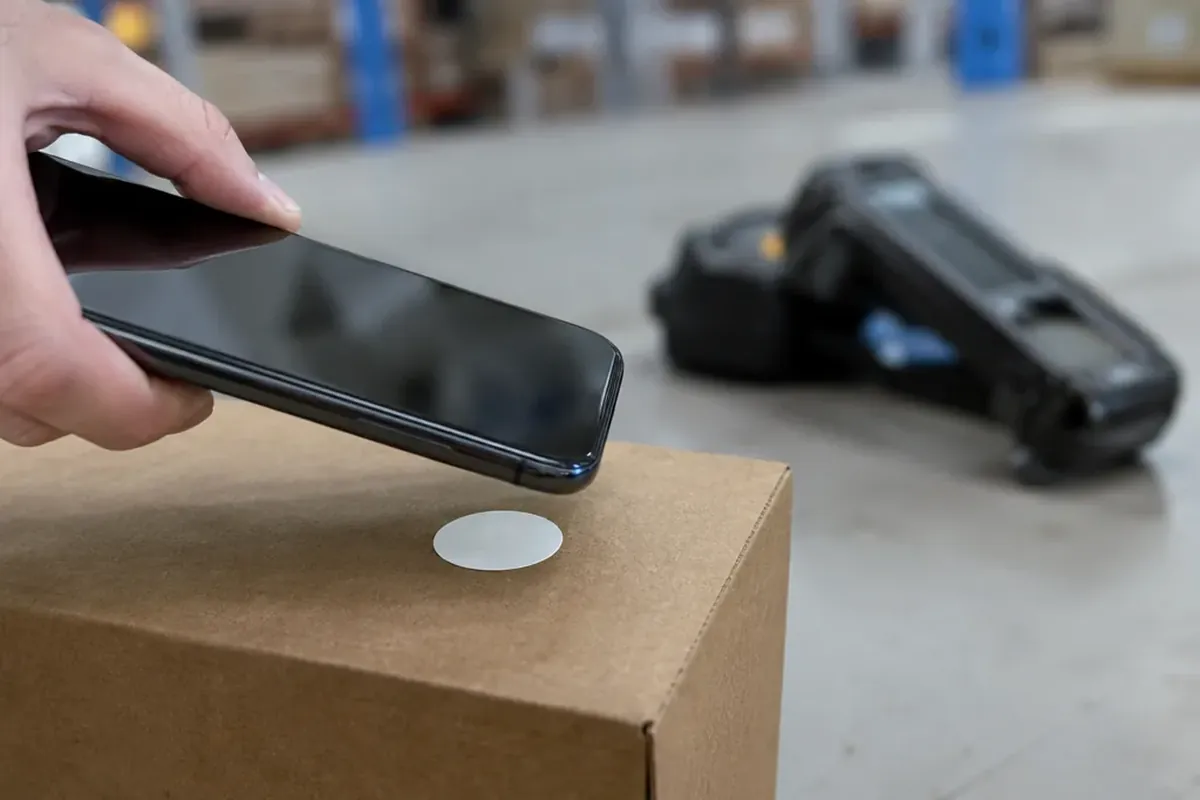
RFID vs NFC comes down to scope, range, and interaction. RFID is the broad family of radio-frequency identification technologies; NFC is its short-range, 13.56 MHz subset. Use NFC when a person should deliberately tap a phone or card. Use the appropriate RFID band when the job calls for anything from close identification to reading many tagged items across a warehouse.
RFID vs NFC: the short answer
Every NFC tag is an RFID tag, but not every RFID tag is NFC. RFID spans low frequency (LF), high frequency (HF), and ultra-high frequency (UHF) systems. NFC operates only in the HF band and adds standardized data formats and interaction modes designed for smartphones.
The practical distinction is simple. NFC is built for a close, intentional interaction with one device at a time. RFID can identify tags over different distances and, in UHF systems, handle groups of tags in a single reading pass. A phone tapping a product tag and a reader counting tagged cases are both radio-frequency interactions, but they are different workflows.
Frequency and range determine the job
RFID frequency affects both range and behavior. LF RFID operates at 125–134 kHz and is used for applications such as animal implants and access cards. HF RFID operates at 13.56 MHz, the same band as NFC. UHF RFID uses 860–960 MHz; its exact allocation varies by region.
| Technology or band | Frequency | Typical stated range | Example fit |
|---|---|---|---|
| LF RFID | 125–134 kHz | A few centimeters | Animal implants, access cards |
| HF RFID | 13.56 MHz | Up to about 1 meter | Library and asset-tracking chips using ISO 15693 |
| NFC | 13.56 MHz | About 4 cm; certified range 2 cm | Phone taps and contactless payments |
| Passive UHF RFID | 860–960 MHz | About 1–15 meters | Inventory reading |
| Active RFID | Battery-powered; band varies by system | More than 100 feet | Longer-range tagged assets |
NFC uses inductive near-field coupling, while UHF RFID uses backscatter coupling. The NFC field falls with the third power of distance, which is why its usable range is measured in centimeters rather than meters. That limitation is intentional: a card or phone must be held close to the reader.
How RFID and NFC exchange data
Standard RFID outside NFC is typically a reader-to-tag exchange: the reader requests data and the tag responds. Passive RFID and NFC tags have no battery. They draw energy from the reader’s electromagnetic field and cannot start a conversation on their own.
NFC also supports three defined modes. In Reader/Writer mode, an NFC reader reads or writes a tag. In Card Emulation mode, a phone can act like a contactless card; NFC phones support EMV Contactless, which is built on ISO 14443. In Peer-to-Peer mode, two active NFC devices exchange data directly, such as when two smartphones are held together to share contact information.
Match the reader and tag to the workflow
An NFC reader can be a compatible phone or a dedicated reader. That makes NFC a natural fit for a product-information tap or a payment interaction, where one person intentionally presents one device. NFC reads one device at a time, which is a feature when the interaction must be specific.
For warehouse inventory, UHF RFID is built for a different task. ISO/IEC 18000-63, also called EPC Gen2, supports anti-collision for large tag populations. A UHF system can read dozens of tags in a pass without line of sight, rather than requiring an individual tap for every item.
- Define the interaction. Choose a deliberate phone or card tap when the experience is customer-facing or transaction-specific.
- Define the read volume. Choose a UHF inventory workflow when many tags must be identified in one pass.
- Choose the tag architecture. A dual-tech label places an NFC chip and a UHF chip on one carrier, so the same item can support a smartphone tap and a logistics portal read.
RFID vs NFC cost: compare tags and readers
For quantities above 100,000, passive UHF RFID inlays cost about $0.05–$0.15 each. A basic NFC tag such as NTAG213 costs about $0.10 in volume, while a secure AES-capable NFC tag such as NTAG424 DNA can cost up to $2.00 or more. Those tag prices describe different capabilities, not a universal winner.
Reader infrastructure changes the comparison. NFC can be less expensive to deploy when existing smartphones serve as readers. UHF RFID requires specialized handheld or portal readers. A useful cost estimate therefore combines tag quantity and chip capability with the readers required at every operating point.
Security depends on implementation, not the label
NFC is generally safer than standard RFID mainly because its extremely short range makes unauthorized reading possible only from centimeters away. Proximity alone is not a security design. An NFC chip that simply returns an ID provides little protection, while encryption and authentication can materially change the result.
Security capabilities vary by chip. NTAG213 has no encryption. MIFARE Classic uses Crypto-1, which is known to be vulnerable. NTAG424 DNA supports AES-128, and DESFire EV3 is AES-based. NFC also supports encryption and mutual authentication. With Secure Unique NFC, each tap can produce a one-time token; a system that recognizes a reused token can reject a replay attempt.
Three misconceptions that lead to the wrong choice
NFC is not Bluetooth
NFC operates at 13.56 MHz; Bluetooth operates at 2.4 GHz. NFC reaches up to 4 cm, while Bluetooth Low Energy can reach up to 100 meters. NFC transfers up to 424 kbit/s and connects in under 0.1 seconds without pairing; BLE reaches up to 2 Mbit/s, but Bluetooth usually needs a pairing process that takes several seconds. A batteryless NFC tag uses no power, whereas Bluetooth requires a power source.
A passive NFC tag cannot track a person
A passive NFC tag has no battery, Bluetooth transmitter, or GPS function. It cannot send its location and becomes active only when brought within centimeters of a reader. Privacy questions can arise after a tap: a URL launched by the tag can log an IP address, timestamp, and device type. That logging comes from the destination, not from the tag tracking anyone.
RFID is not automatically better than a smart tag
Bluetooth and UWB smart tags are designed to help locate lost items through a global network. RFID is the practical choice for inventorying thousands of items in a warehouse. The technologies solve different problems; an NFC chip in a smart tag can be a secondary feature rather than its location system.
Frequently Asked Questions
What are the key differences between NFC and RFID?
RFID covers LF, HF, and UHF technologies, while NFC is a standardized HF RFID subset that operates only at 13.56 MHz. NFC is designed for very close, often two-way interactions; UHF RFID is designed for longer-range reading and large tag populations.
What is RFID?
RFID, or radio-frequency identification, identifies tags using radio waves. Its main frequency bands are LF at 125–134 kHz, HF at 13.56 MHz, and UHF at 860–960 MHz.
What is the range of NFC?
NFC reads at about 4 cm, with a certified conforming range of 2 cm. Its short range is a deliberate design feature for intentional taps.
Is NFC just Bluetooth?
No. NFC uses 13.56 MHz and works over centimeters; Bluetooth uses 2.4 GHz and can reach up to 100 meters with BLE. NFC also connects without pairing in under 0.1 seconds.
Is RFID better than a smart tag?
Not in every use case. Smart tags using Bluetooth or UWB are better suited to recovering lost items through a global network. RFID is practical for reading thousands of tagged items in a warehouse.
Can an NFC tag track you?
A passive NFC tag cannot track you because it has no battery, transmitter, or GPS. A tap can, however, open a URL whose service logs information such as IP address, timestamp, and device type.